
2026-10-14
Japan sits at one end of a scale, and the scale has a name
日本はものさしの端にいて、そのものさしには名前がある
Japan sits at one end of a scale, and the scale has a name.
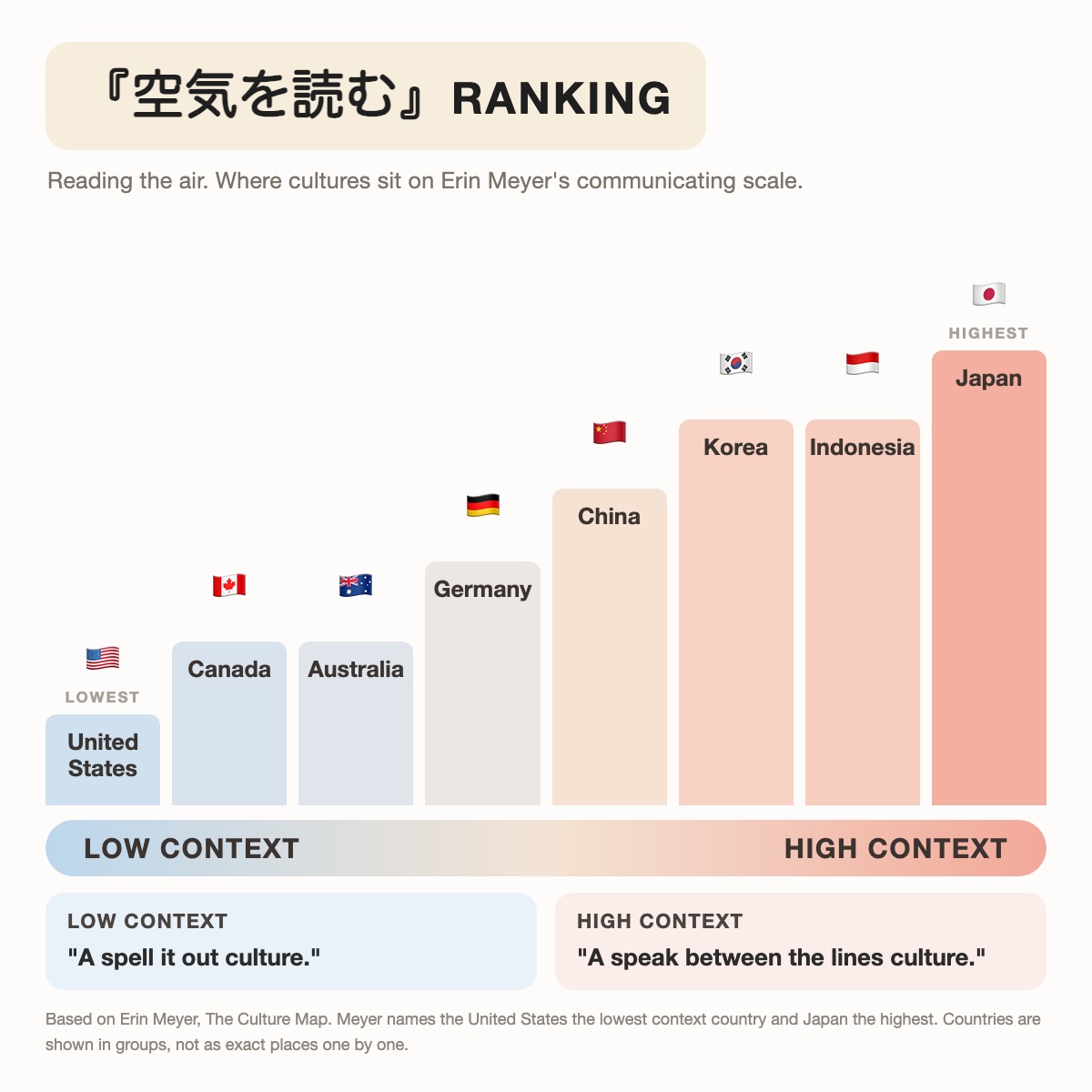
Erin Meyer's Culture Map places every culture somewhere between low context and high context. Low context means the message is in the words. Meyer calls it a spell it out culture. High context means the message is around the words. She calls that a speak between the lines culture.
Meyer puts the United States at the lowest context end of that scale, and Japan at the highest. Her reason for Japan is that it is an island nation with a long shared history, so people can read the air.
Read the air is kuuki o yomu (空気を読む). It is not a quirk, and it is not mystical. It is the far end of a scale that every culture is already standing on.
Here is the part that matters if you have moved here. The difficulty is not where Japan sits. It is the distance between where Japan sits and where you came from.
Someone arriving from the United States is crossing the whole scale. Someone arriving from Korea or Indonesia is crossing almost none of it.
Meyer's advice for working across that gap is one line. Be a low context communicator and a high context listener.
And it runs both ways. The Japanese colleague talking to you is crossing the same distance.
日本は、あるものさしの端にいます。そして、そのものさしには名前があります。
エリン・メイヤーの『The Culture Map』は、どの文化もローコンテクストとハイコンテクストのあいだのどこかに置きます。ローコンテクストとは、伝えたいことが言葉の中にあるということ。メイヤーはこれを「はっきり言葉にする文化」と呼びます。ハイコンテクストとは、伝えたいことが言葉のまわりにあるということ。彼女はこちらを「行間で話す文化」と呼びます。
メイヤーは、このものさしの最もローコンテクストな端にアメリカを、最もハイコンテクストな端に日本を置いています。日本をそこに置く理由は、長く歴史を共有してきた島国だから、空気を読めるということです。
その「空気を読む」が、これです。特殊な癖でもなければ、神秘的なものでもありません。どの文化もすでに立っている、1本のものさしの端です。
ここからが、日本に移ってきた人にとって大事なところです。難しさは、日本がどこにいるかではありません。日本の位置と、自分が来た場所との距離です。
アメリカから来た人は、このものさしを端から端まで渡ることになります。韓国やインドネシアから来た人は、ほとんど渡りません。
その差を越えて働くためのメイヤーの助言は、一言です。話すときはローコンテクストに、聞くときはハイコンテクストに。
そしてこれは双方向です。あなたと話している日本人の同僚も、同じ距離を渡っています。
Comments
No comments yet.
Log in to like, comment, and repost.