
2026-10-12
Fukuoka has its own word for because
福岡には「から」にあたる言葉がもう一つある
Kara (から) is the word your textbook gives you for because. Fukuoka has its own.
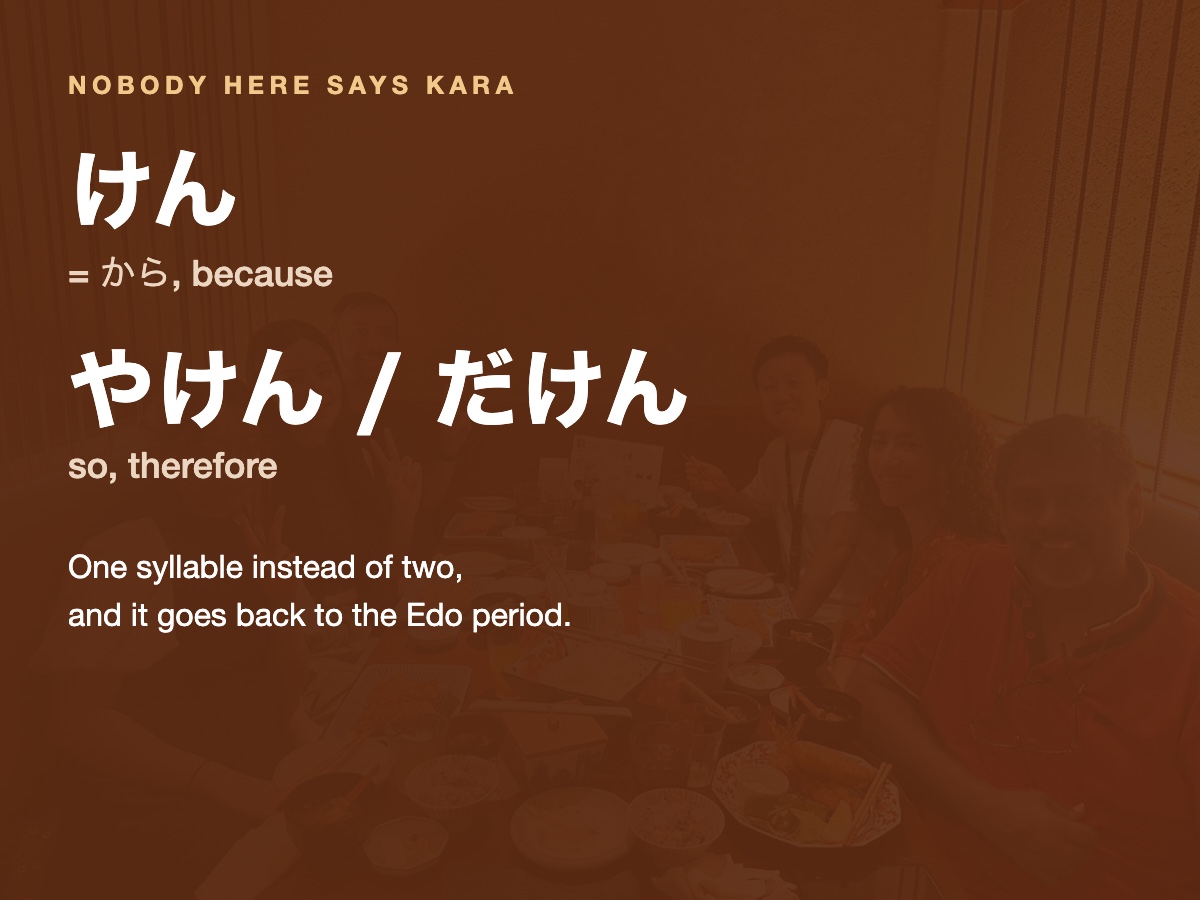
They say ken (けん).
Go nen mo shigoto shitenai ken, yatotte kuren to? (5年も仕事してないけん、雇ってくれんと?) I have not worked in five years, so would you hire me? In standard Japanese that ken would be node (ので).
That is the whole thing. Same slot in the sentence, same job.
It is older than it sounds. The dictionary lists ken as a conjunctive particle meaning because, and the citation it gives is a puppet play from 1718, Hakata Kojorou Namimakura. This is not a recent shortcut.
Two forms you will hear a lot. Yaken (やけん) and daken (だけん). Both are da (だ) plus ken, so they open a reply with so or therefore. Yaken is the looser of the two.
And there is one use that is pure tone. Daken at the front of a sentence, said hard, means that is what I just told you. Someone mishears your age and you come back with daken sanjussai tte itteru yarou ga (だけん30歳って言ってるやろうが). The word has not changed. The volume has.
Here is what to take from it. You do not need to say ken yourself. But if you are reading a room in Fukuoka and you hear daken land heavy, that tells you something. It tells you where the conversation is going. You only get that if you know the word is there.
教科書が「だから」として教えてくれるのは「から」です。福岡には、もう一つあります。
「けん」です。
「5年も仕事してないけん、雇ってくれんと?」。5年も仕事をしていないので雇ってくれませんか、です。標準語の「ので」がそのまま「けん」になります。
それだけです。文の中の場所も、役割も同じです。
見た目より古い言葉です。辞書には理由・原因を表す接続助詞として載っていて、挙がっている用例は1718年の浄瑠璃『博多小女郎波枕』です。最近の略し方ではありません。
よく耳にする形が2つあります。「やけん」と「だけん」。どちらも「だ」と「けん」で、返事の頭に置いて「だから」にあたります。「やけん」のほうがくだけています。
そして、言い方だけで意味が変わる使い方があります。文の頭の「だけん」を強く言うと、さっきそう言ったでしょう、になります。年齢を聞き間違えられて「だけん30歳って言ってるやろうが」と返すときのあれです。言葉は変わっていません。変わったのは強さです。
ここが持ち帰るところです。自分で「けん」を使う必要はありません。ただ、福岡で場の空気を読もうとしているときに「だけん」が強く落ちたなら、それは会話がどこへ向かっているかの手がかりです。その言葉があると知っていないと、手がかりとして受け取れません。
Comments
No comments yet.
Log in to like, comment, and repost.