
2026-10-11
Daijoubu desu means yes. It also means no
「大丈夫です」は、はいでもあり、いいえでもある
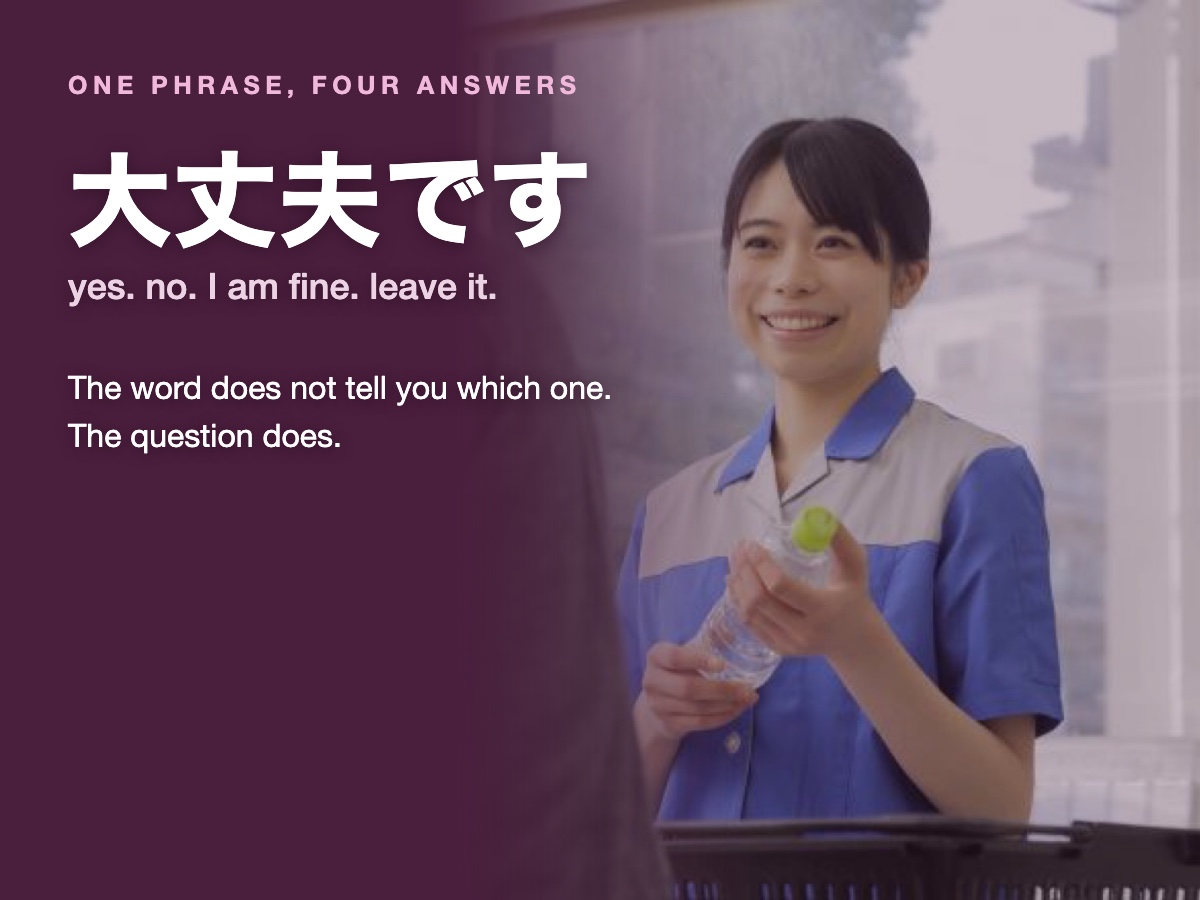
Daijoubu desu (大丈夫です) means yes. It also means no. Same two words, same face.
At a convenience store, the staff asks hashi wa otsuke shimasu ka (お箸はお付けしますか), do you want chopsticks. You answer daijoubu desu. Here it means no, thank you.
Someone offers to carry something for you. Daijoubu desu is I am fine, do not worry.
Your manager asks if you can take one more task. Daijoubu desu is yes, I can.
A doctor asks if it hurts. Daijoubu desu is it does not.
Yes, no, I am fine, leave it. One phrase.
It did not start out this way. The first meaning in the dictionary is a fine, strong man. The sense of very sturdy is cited from 1530, and the sense of no danger, no problem from 1776. The use you meet every day, answering whether something is needed or possible or agreed to, is listed as a recent one. Japanese speakers find it ambiguous too.
So how do you handle it. Two things.
When you hear it, do not read the word. Read the question. If the question was shall I add something, it is a no. If the question was can you, it is a yes.
When you say it, be careful at work. Japanese business guides tell you to avoid daijoubu desu there, because it reads both ways. For yes, say mondai arimasen (問題ありません). For no, say hitsuyou arimasen (必要ありません).
A dictionary gives you the meaning of the word. The meaning that counts is the one the question gave it.
「大丈夫です」は、はい、という意味です。同時に、いいえ、という意味でもあります。同じ言葉、同じ顔で。
コンビニで「お箸はお付けしますか」と聞かれます。そこで「大丈夫です」と答えます。ここでは、いりません、という意味です。
荷物を持ちましょうか、と言われたとき。「大丈夫です」は、平気です、気にしないで、の意味です。
上司から、もう1件お願いできますか、と聞かれたとき。「大丈夫です」は、できます、の意味です。
医者に、痛みますか、と聞かれたとき。「大丈夫です」は、痛くありません、の意味です。
はい、いいえ、平気です、いりません。全部ひとつの言い方です。
最初からこうだったわけではありません。辞書では、まず「立派な男子」「ますらお」です。「とても丈夫だ」の意味は1530年の用例、「危険がない、間違いない」の意味は1776年の用例が挙がっています。いま毎日出くわすほうの使い方、つまり必要か・可能か・承諾かを尋ねたり答えたりする使い方は、近年のものとして載っています。日本語を話す人にとっても分かりにくい言葉です。
では、どう付き合うか。2つあります。
聞くときは、言葉ではなく質問のほうを読んでください。「付けますか」と聞かれたあとなら、いいえ、です。「できますか」と聞かれたあとなら、はい、です。
自分が言うときは、仕事の場で気をつけてください。ビジネスの場では「大丈夫です」は肯定とも否定とも取れるので控えたほうがよい、とされています。はいの意味なら「問題ありません」、いいえの意味なら「必要ありません」です。
辞書が教えてくれるのは言葉の意味です。効いてくるのは、その質問が与えた意味のほうです。
Comments
No comments yet.
Log in to like, comment, and repost.