
2026-10-09
Fukuoka has two forms where your textbook has one
教科書が1つで済ませているところを、福岡は2つに分けている
The Japanese you studied has one way to say this. Fukuoka has two, and the difference is real grammar, not slang.
Take rain. In standard Japanese, ame ga futte iru covers both of these.
The rain is coming down right now.
The rain has fallen and the road is wet.
Same words for both. You work out which one from context, every single time.
Here they are two different sentences.
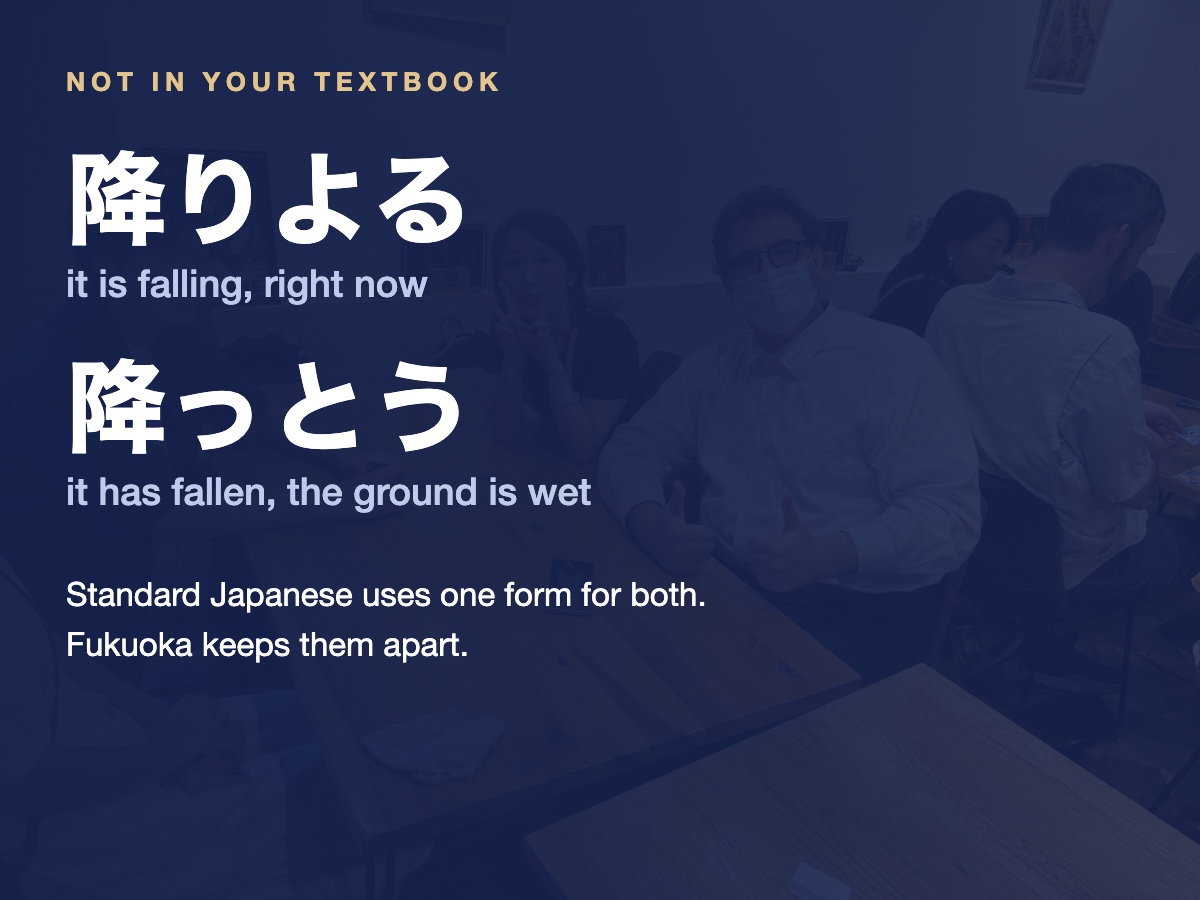
Ame ga furiyoru (降りよる). It is falling. In progress, happening while you watch.
Ame ga futtou (降っとう). It has fallen. The event is finished and you are looking at what it left behind.
Yoru is the one still moving. Tou is the one already done. You will hear tou all day in Fukuoka: shittou (知っとう) for I know, tottou (取っとう) for I have got it.
This is not slang. It is a distinction this side of the country makes and standard Japanese does not.
Here is why it is worth your attention. English already makes the same split, with is falling and has fallen. Japanese class made you give it up and squeeze both into te iru. But it's a different story in Fukuoka.
Listen for yoru and tou for one week. You will hear the difference.
習った日本語では言い方が1つしかないところを、福岡は2つに分けています。しかもこれは、崩した言い方ではなく文法です。
雨で考えてみます。標準語の「雨が降っている」は、次のどちらにも使えます。
今まさに雨が降っている。
雨はもう降り終わって、道が濡れている。
同じ言葉で両方です。どちらなのかは、そのたびに前後から判断しています。
福岡では、これが別の文になります。
「雨が降りよる」。降っている最中です。見ている目の前で進んでいます。
「雨が降っとう」。降り終わったあとです。残ったものを見ている状態です。
「よる」はまだ動いているほう。「とう」はもう終わったほう。福岡では「とう」を一日中耳にします。「知っとう」は知っている、「取っとう」は取ってある、です。
これは崩した言い方ではありません。標準語が区別しないところを、こちら側が区別しているというだけのことです。
ここが面白いところです。英語はもともと is falling と has fallen で同じ区別をしています。日本語の授業でそれを手放して、両方を「〜ている」に押し込めさせられたわけです。福岡では話が違います。
1週間、「よる」と「とう」だけ耳で追ってみてください。違いが聞こえるようになります。
コメント
まだコメントはありません。
ログインすると、いいね・コメント・リポストができます。